A Parliamentary Standing Committee on Commerce has urged the Indian government to swiftly conclude the proposed India-US Bilateral Trade Agreement (BTA), while ensuring India's interests are protected, recommending complete exemption for key export products like generic medicines and smartphones from future US tariff increases.

The escalation in the diplomatic row between India and Canada will not have an impact on the bilateral trade and investment ties between the two countries, government sources said on Tuesday. They also said that the bilateral trade value is not significant and Canadian funds can route their investments through Singapore, the UAE and the US. "India is a preferred investment destination," they said.

A US trade representative described India as a 'tough nut to crack' during trade agreement negotiations in Washington, highlighting India's protection of its agricultural markets and the ongoing discussions on specific commodities.

Under the defence partnership, India and the UAE are eyeing defence industrial collaboration and cooperation in advanced technologies, cyberspace training, special operations, interoperability of their militaries and counter terrorism.
Prime Minister Narendra Modi's visit to New Zealand culminated in the elevation of bilateral ties to a strategic partnership, with a focus on doubling trade and enhancing cooperation in sports and the Indo-Pacific region. Modi and his counterpart Christopher Luxon attended a sports showcase, acknowledging a century of sporting ties and discussing future collaborations, including India's preparations for the Commonwealth Games 2030. The visit also saw 18 concrete outcomes and 10 agreements signed, alongside discussions with business leaders.

India and Russia on Tuesday set a target of $100 billion in annual trade volume by 2030 and vowed to develop a robust bilateral payment settlement mechanism using national currencies. The two sides also inked a total of nine agreements to further broadbase cooperation in a range of areas including in the economic domain following summit talks between Prime Minister Narendra Modi and Russian President Vladimir Putin.

Focusing on closer economic ties with India during the 31st year of diplomatic relations with New Delhi, South Korea has set a target of $4 billion of bilateral trade this year and is mulling augmenting overseas development assistance to the country.
Prime Minister Narendra Modi concluded his three-nation tour in New Zealand, where he and his counterpart Christopher Luxon elevated bilateral ties to a strategic partnership. The visit focused on doubling trade by 2030 and expanding cooperation in the Indo-Pacific region, marking the first visit by an Indian PM in 40 years.
Terming India's ties with the ASEAN as a 'pillar' of its 'Look East' policy, Prime Minister Manmohan Singh on Wednesday proposed a bilateral trade target of $50 billion by 2010 and sought boosting of cooperation with the key ten-member grouping in technology, health care, climate change and tourism.

India and Canada aim at achieving a bilateral trade target of $15 billion in the next five years, even as both countries are beginning a series of negotiations to have a Comprehensive Economic Partnership Agreement (CEPA) soon that would yield significant economic benefit for both countries and lower tariffs over a large number of products, says Peter Van Loan, Minister of International Trade, Canada.

India and the US are expected to sign the first phase of a bilateral trade agreement by mid-March, which will result in the US lowering import duties on Indian goods. India will then begin reducing import duties on certain US goods.
India and the US are expected to sign the first phase of a bilateral trade agreement by mid-March, which will result in the US lowering import duties on Indian goods. India will then begin reducing import duties on certain US goods.
Eurozone crisis has hit the India-France bilateral trade and achieving the USD 12 billion target (of the trade) would be difficult this year, French Ambassador to India, Francois Richier, said.

Prime Minister Narendra Modi's visit to Italy concluded with the elevation of India-Italy relations to a Special Strategic Partnership, focusing on enhanced cooperation across various sectors.
India and Russia have agreed to double bilateral trade within 3 years to $10 billion.

Lutnick said that these countries have to understand that if "you want to sell to the US consumers, you've got to play ball with the President of the United States."

A bipartisan group of US Senators has agreed to fast-track a bill allowing the President to impose sanctions on major purchasers of oil from Russia and Iran. This legislation, known as the Lindsey O. Graham Sanctioning Russia and Iran Act of 2026, aims to restrict funding for Russia's war efforts and Iran's energy and weapons sectors, potentially impacting countries like China and India through tariffs and other restrictions.
India and China are aiming to double their bilateral trade to about $10 billion by 2005.

Amidst global energy market volatility driven by the West Asia crisis, Russia has proposed increasing its crude oil and natural gas supplies to India, strengthening bilateral energy ties and aiming for USD 100 billion in annual trade by 2030.

The decision to revise the target by $10 was taken in New Delhi at the India-Africa Ministers Round Table conference chaired by Commerce, Industry & Textiles Anand Sharma.

In reflection of their growing congruence in areas of defence and security, the two sides, following the Modi-Mitsotakis talks, agreed to set up an institutional dialogue at the level of national security advisors, and boost defence industrial cooperation.

Prime Minister Narendra Modi on Thursday said the India-UK free trade pact will boost MSMEs and create jobs, and exuded confidence that the target of doubling bilateral trade will be achieved ahead of the target date of 2030.

Tensions in West Asia have dramatically escalated as Israel launched targeted military operations against Iran, triggering widespread blasts across strategic cities, following earlier Iranian projectile attacks on Israel.

The harsh truth is that the US is no longer a reliable partner, cautions Ramesh Menon.

Notwithstanding the economic complementarities and the host of agreements for deepening economic relation on a host of areas, both sides share common viewpoints on the foreign policy domain and seek common grounds to serve as a counterweight to China, notes Dr Rajaram Panda.

Indian-American lawmakers are encouraging the diaspora to actively participate in US politics and run for public office at all levels. This call comes amidst increasing incidents of anti-India and anti-Hindu hate, with leaders emphasising that political representation is crucial to address community concerns and ensure their voices are heard.

A US federal government commission has raised concerns about the state of religious freedom in India, recommending its designation as a 'Country of Particular Concern' and suggesting targeted sanctions.
Buoyed by growth in bilateral trade with China during the first eight months this year, the government on Monday exuded confidence in achieving the $10 billion target set for next year.
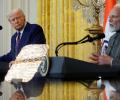
India and the US have entered a new phase in their relationship, marked by greater parity, point out Harsh V Pant and Vivek Mishra.

'A deal will only be possible if India stops buying Russian oil -- but even then, New Delhi must not compromise its core red lines.'

Not a single retail outlet ran dry. Every household that wanted a cylinder got one. India faced neither a 1991 moment nor a 2013 one. Macroeconomic stability held. This was not an accident, and it was not luck alone. It was the work of a government that chose to act as it had during the pandemic -- deliberately and gradually, building one measure upon another rather than reaching for a single dramatic lever, explains V Anantha Nageswaran, chief economic advisor to the Government of India.

There is no direct impact of the Russia-Ukraine crisis on India in terms of bilateral trade but a surge in oil prices poses considerable risk to the economy, an analyst report said on Friday. International oil prices which have surged past $100 per barrel "pose risks to external stability and currency movement," a Bank of Baroda Economics Research report said. Russia has launched military operations against Ukraine, stoking fears of significant disruption in the region, including loss of life. The West is ramping up financial sanctions against Russia and support for Ukraine.
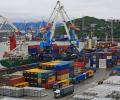
The escalating trade war between the US and China is expected to benefit Indian exporters in increasing their shipments to the American market, according to experts. Federation of Indian Export Organisations (PTI) President S C Ralhan said that imposition of higher tariffs by the US on China will shift demand towards India, which exported goods worth Rs 86 billion to the US in 2024-25.

Pakistan Prime Minister Shehbaz Sharif expressed 'forever grateful' to US President Donald Trump for his 'timely' intervention in securing a ceasefire with India following a military conflict last year, a claim India has consistently rejected.

India has rejected a report by the US Commission on International Religious Freedom (USCIRF) that criticised India's record on religious freedom and called for linking US security assistance and trade to improvements in this area.

The Indian government has dismissed the US Commission on International Religious Freedom's (USCIRF) report on religious freedom in India, stating that it does not recognise the commission's authority to comment on the rights of Indian citizens.

'There are very few issues and a political call needs to be taken about some of them.'

The Indian industry is paranoid about the USA's plan to impose reciprocal tariffs and wants early conclusion of a bilateral trade agreement, sources said on Wednesday. They said that the talks for the proposed bilateral trade agreement are going well.
Indian and US officials will begin deliberations on the proposed bilateral trade agreement in Washington from Wednesday with an aim to iron out issues and give an impetus to the negotiations.

The Beijing summit may have reduced immediate diplomatic uncertainty, but it did not resolve the deeper structural contest between the United States and China. That contest appears likely to define the coming decade, notes Varun Arya.
